Custom Landscape Walling Stone Factory
Procurement for large-scale masonry projects requires a balance between material density and structural integrity. While aesthetic-grade stone often prioritizes variety, the primary failure mode in landscape applications is delamination during rapid freeze-thaw cycles. Our manufacturing process focuses on maintaining dimensional tolerance to ensure that every unit fits the specified architectural grid without the need for on-site trimming.
Technical Note: For load-bearing retaining walls exceeding 1.2 meters, a minimum stone density of 2,400 kg/m³ is required to prevent structural creep under hydrostatic pressure.
Material Selection and Density Consistency
The porosity of stone determines the lifespan of the wall in high-moisture environments. High absorption rates lead to internal spalling when water freezes within the capillary pores and expands. We utilize a controlled compression process on natural stone to keep the water absorption rate below 3%, ensuring the surface finish remains intact over a 20-year exposure cycle.
Structural Metrics
- Compressive strength: 60-120 MPa
- Frost resistance: Class 4 (High)
- Modulus of elasticity: <20 GPa
Dimensional Specs
- Length variance: ± 2mm
- Width tolerance: ± 1mm
- Thickness flatness: < 3mm
Where Cheaper Alternatives Fall Short
Low-cost suppliers often overlook internal structural fractures that are not visible to the eye. When these stones are subjected to the mechanical stress of a retaining wall, the internal fissures propagate, leading to catastrophic shear failure. Our quality control utilizes ultrasonic pulse velocity testing to identify internal voids before the stone is cleared for export.
Consistency in color batch is another frequent complaint from wholesale buyers. Variations in mineral composition across different shipments can result in a patchy appearance on a large facade. We manage this through strict quarry-face sourcing, ensuring that a single order is pulled from a limited geological strata to maintain visual uniformity.
What the Design Has to Balance
The trade-off between weight and installation speed is a primary consideration for procurement officers. Heavier stones provide better stability through gravity alone but increase labor costs and require heavy lifting machinery. We provide various hollow-core configurations to reduce weight by 30% without compromising the structural strength of the outer face.
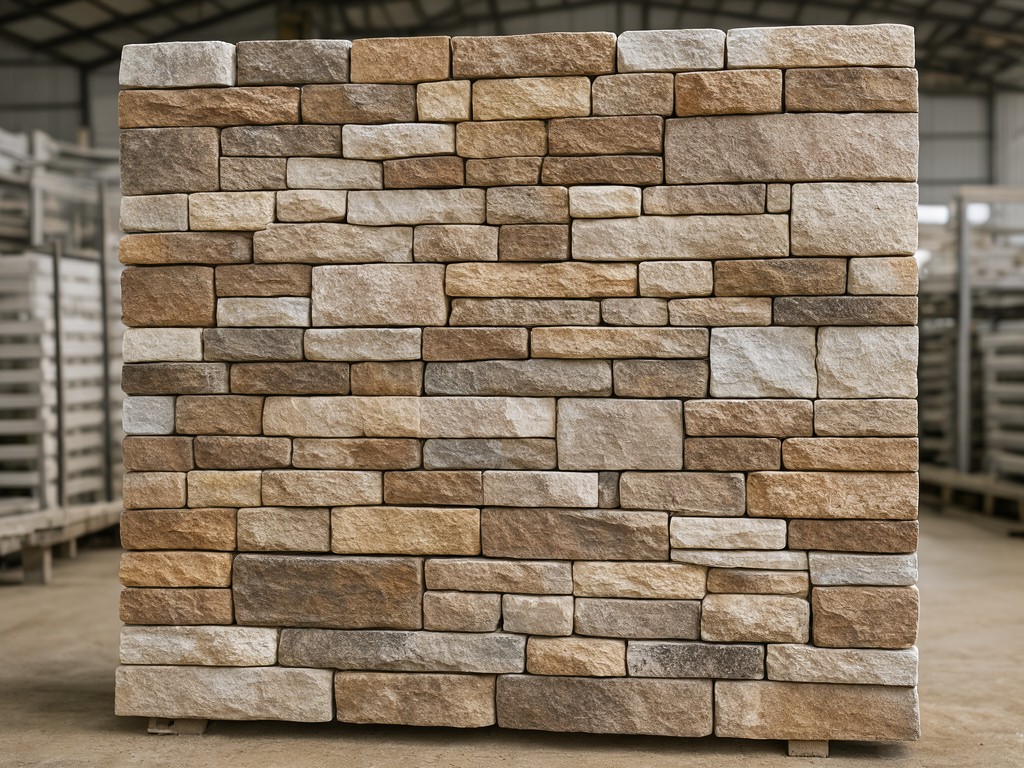
| Configuration Type | Standard Dimensions | Primary Use |
|---|---|---|
| Solid Split Face | 300x150x100mm | High-load retaining |
| Veneer Panel | 600x300x20mm | Decorative cladding |
| Interlocking Block | 200x100x150mm | Garden walls |
Buying Mistakes That Lead to Returns
Failing to specify the coefficient of thermal expansion for specific climates often leads to premature joint cracking. If the stone is installed in a rigid mortar without flexibility, seasonal movement will cause the face to fail. We recommend specific joint widths based on the local temperature delta of the project site.
Who Uses It and Where It Matters
Commercial developers require high-volume consistency to meet tight project schedules. In contrast, residential landscape distributors focus on texture variety and ease of handling for DIY. Our factory scales between both, providing batch traceability for industrial contracts and custom finishing for retail distributors.
Questions Ask Before Ordering
What is the load rating for the interlocking units?
The rating depends on the base compaction and the wall height, typically supporting up to 5 meters of soil for standard blocks.
How do you handle shipping protection for fragile edges?
We use heat-treated pallets and reinforced shrink-wrap to prevent impact damage during sea freight transit.