Custom Ivory Travertine Subway Backsplash for Sale: What Buyers Check Before Ordering
Technical Note: Natural porosity in ivory travertine varies by batch. For high-moisture environments, a deep-penetrating sealer is mandatory to prevent capillary absorption and subsequent staining, which can compromise the structural integrity of the substrate over time.
Comparing Standard Configurations
The choice between tumbled and honed finishes directly impacts the maintenance frequency and the visual profile of the installation. A tumbled surface retains the natural voids and pits of the stone, which increases the surface area for organic accumulation in commercial-grade kitchen environments. Procurement officers must weigh the aesthetic demand of the raw edge against the operational cost of deep-cleaning a honed, non-porous alternative.
Tumbled Grade
High-texture profile with irregular edges. Best for residential-led projects where organic variation is prioritized over rapid-wipedown capabilities.
Honed Grade
Flat-surface finish with matte luster. Optimized for high-traffic zones where hygiene standard compliance and easy sanitation are critical metrics.
Assumptions Buyers Make
Many distributors incorrectly assume uniform color consistency across large-scale container shipments. Because travertine is a sedimentary metamorphic rock, the ivory pigment shifts based on the mineral density of the specific quarry vein. Relying on a single sample swatch without requesting batch-specific photometer testing often leads to high rejection rates during the final installation phase of multi-unit hospitality or residential developments.
Dimensional thickness variance is another frequent failure point. While standard subway tiles are nominally 8mm, natural stone can fluctuate by $pm$1.5mm across a single pallet. This variance requires thicker mortar-set applications to achieve a level plane, which increases the total material weight load on the backsplash substrate.
Usage Scenarios and Segments
Commercial-grade kitchen operators specify these tiles for zones where thermal shock is minimal but impact is frequent. In these settings, the stone must withstand temperature fluctuations from cooking ranges without the cracking seen in inferior ceramic alternatives. Private-label brands targeting luxury residential markets often utilize the ivory travertine for accent walls where the tactile nature of the natural stone justifies the premium price point per square meter.
| Parameter | Specification Range | Tolerance Metric |
|---|---|---|
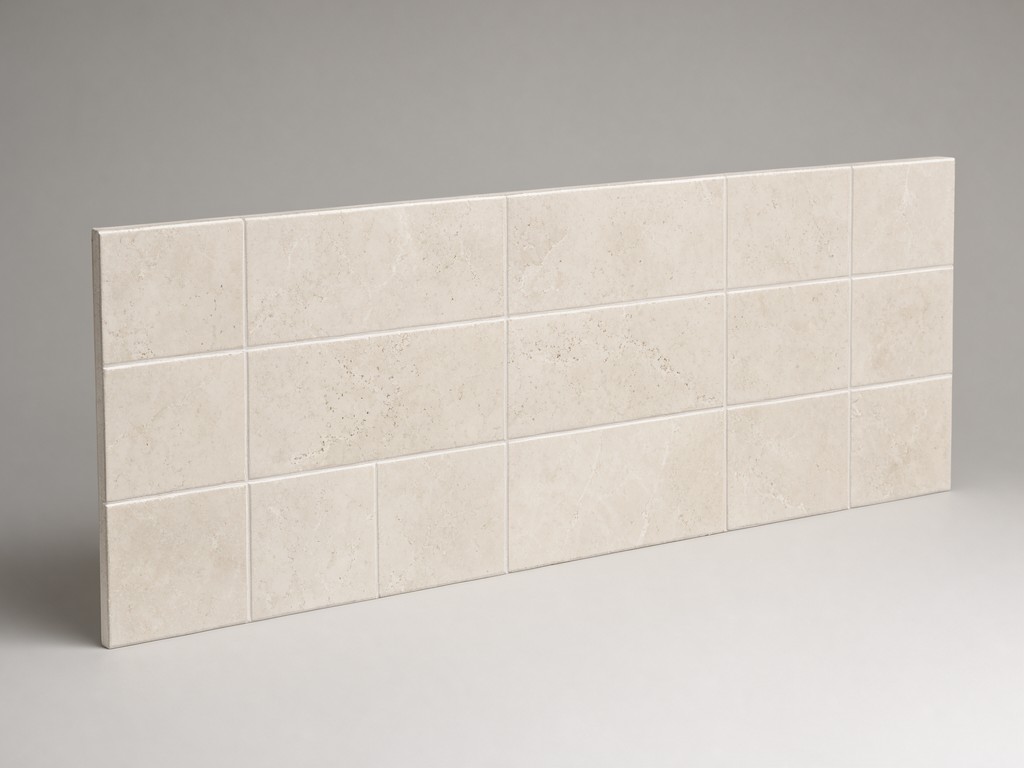
| Standard Dimensions | 75mm x 150mm | $pm$0.5mm |
| Thickness Range | 8mm - 12mm | $pm$1.0mm |
| Water Absorption | <3% | ASTM-standard compliant |
Inspection Items and Testing
Quality control protocols at the factory focus on density mapping to ensure structural stability during transit. We utilize ultrasonic pulse velocity to detect internal fractures that are not visible to the eye but indicate structural weakness. Furthermore, dimensional checks are performed on every 50th unit to ensure that the grout line width remains consistent across the entire order.
- Water absorption rate testing to verify sealer efficacy.
- Surface abrasion resistance checks against honed-finish specifications.
- Colorimetric delta-E analysis for batch consistency.
Care and Service Life
The long-term aesthetic of ivory travertine depends on the chemical compatibility of the cleaners used. Acidic cleaners common in food service will etch the calcium carbonate surface, leading to permanent pitting and loss of the ivory luster. We recommend neutral-pH cleaners exclusively to maintain the stone's refractive index over a 10-year service cycle.
Ordering, Tooling and Lead-Time
Custom-cut edge profiles require a lead time of 6-8 weeks due to the precision water-cutting requirements. Standard subway shape orders are typically available for shipment within 3 weeks depending on current inventory levels. Minimum order quantities for custom-label branding are set at 500 square meters to ensure batch-level color matching accuracy.
Frequently Asked Questions
Can these tiles be used for outdoor applications?
While possible, direct UV exposure can cause slight fading of the ivory tones unless a high-grade UV-resistant sealer is applied.
What is the weight per square meter for shipping calculations?
Typically 25kg-30kg per square meter depending on the specific thickness and stone density selected.