China Slate Stacked Stone Panels Supplier - Bulk Supply and Specification Guide
Quality disputes in stone cladding start with a consistency gap between shipments. When a retail buyer receives a pallet of stacked stone panels where the variation in thickness exceeds 5mm from the first layer to the fourth, the installation labor costs spike. Installers struggle to level the face against the substrate, leading to uneven mortar lines and structural failure of the adhesive bond. If the back substrate is not perfectly flat, the mechanical shear strength of the panel drops, resulting in delamination after seasonal thermal expansion cycles.
The Problem Buyers Keep Paying For
Most return rates on stacked stone panels are driven by poor edge definition and inconsistent moisture absorption rates. If the slate is not split with a calibrated tolerance, the porous edges of the panels remain porous, allowing water to penetrate behind the cladding. This moisture ingress accelerates freeze-thaw damage, causing the stone face to pop off the mesh-backing. Furthermore, color drift between batches often ruins large-scale commercial projects where a single wall requires a uniform tonal palette across multiple shipping containers.
- Inconsistent mesh-bond adhesion leading to panel slippage during transit.
- Variation in panel depth exceeding +/- 3mm, complicating flat-lay installation.
- Dust and residue on the stone face that indicate mechanical cutting rather than natural splitting.
- Substrate irregularity that prevents a chemical bond with polymer-modified thin mortars.
What Actually Determines Performance
The performance of a slate panel is dictated by the density of the natural stone and the chemical composition of the reinforcement mesh. We utilize high-density polyethylene mesh to ensure that the weight of the stone does not cause material deformation over long-term exposure. The adhesive applied to the back of the slate must be rated for the specific thermal coefficient of the region; otherwise, the stone will pull away from the mesh as the building fluctuates in temperature.
| Usage Condition | Typical Complaint | Specification Requirement |
|---|---|---|
| Exterior Facade (Cold Climate) | Surface spalling and face loss | Water absorption < 3% by 24h |
| Feature Accent Wall | Uneven profile/depth | Thickness variance < +/- 4mm |
| Indoor Residential Living | Mesh peeling/delamination | Reinforced alkali-resistant mesh |
Where This Beats Standard Alternatives
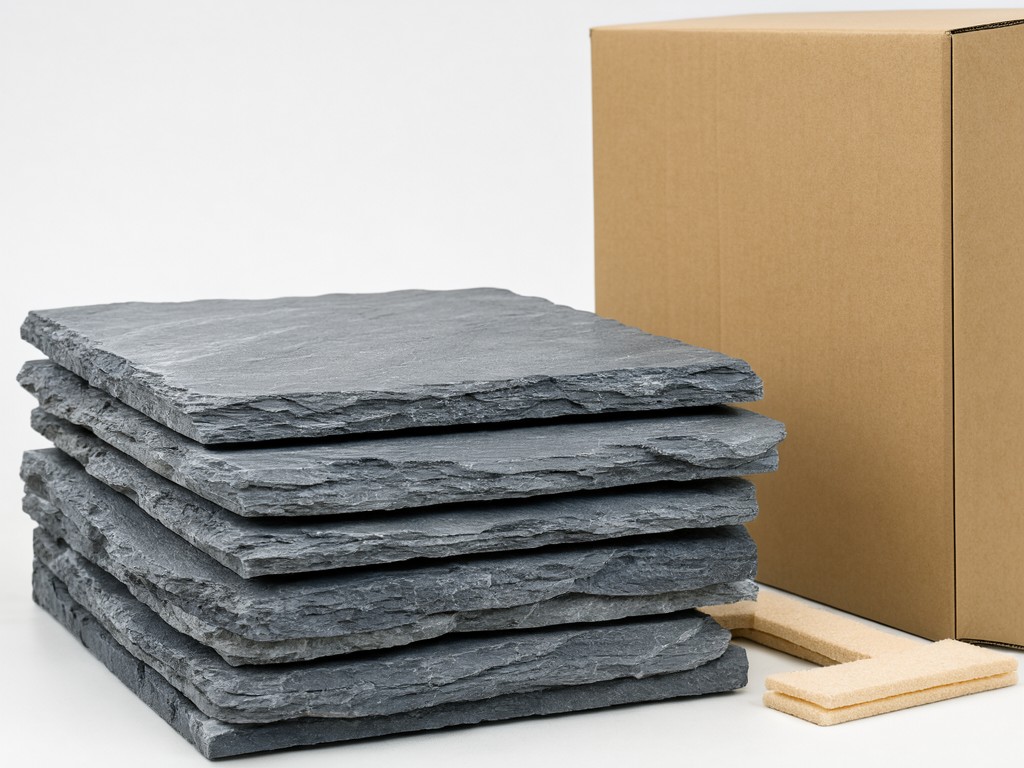
Standard suppliers often use thin-cut slate to save weight, which creates a fragile product prone to cracking during mechanical handling. Our process focuses on natural splitting, which preserves the crystalline structure of the stone. This results in a higher Mohs hardness rating and impact resistance. By maintaining a consistent thickness across the entire panel, we ensure that the final finish is flush without requiring extensive trimming, reducing the waste factor for high-end architectural projects.
Matching the Product to the Buyer's Need
Selecting the right configuration requires balancing the aesthetic intent with structural constraints. For high-volume retail distribution, a "split face" finish with high texture contrast is often preferred for visual impact. For OEM applications in architectural cladding, a "straight-edge" or "squared-cut" panel is necessary to minimize installation time and ensure precise grout lines.
Customisation Options and Their Limits
We offer various panel dimensions and mesh reinforcements to meet specific load requirements. However, buyers must note that natural slate color is inherently variable. We cannot guarantee a 100% color match between different quarry years, but we provide tonal-mapping samples to ensure the batch falls within an acceptable range for your project.
Available Finishes
- Natural Split: Raw texture, high shadow play.
- Honed: Smooth surface, ideal for modern interior use.
- Chiseled: Textured surface for maximum slip resistance.
Reinforcement Types
- Standard Fiberglass Mesh: For dry interior use.
- Aluminum Backing: For high-load bearing exterior facades.
- Custom Size Panels: For specific large-format requirements.
Quality Control
Our inspection protocol includes dimensional checks on every tenth panel to ensure tolerance compliance. We test moisture content to ensure the stone meets the specified absorption rates. We also perform adhesion pull tests on sample batches to verify that the bond between the slate and the mesh can withstand the stresses of international transport.
Ordering, Tooling and Lead-Time
For bulk orders, lead times typically range from 30 to 60 days depending on quarry availability. Custom-cut dimensions for architectural projects require additional 2 weeks for tooling and precision cutting. We provide batch traceability for every shipment, allowing you to reorder from the exact same material source if expansion is needed.
Request technical data sheets or bulk pricing for your next project.
Contact our Engineering Team for a Quotation