Wholesale Natural River Pebble Stone Supplier: What Buyers Should Check Before Ordering
Consistency is established at the source through the mechanical sorting and hydraulic grading process. For bulk landscape projects, the primary failure point is variance in size distribution, which leads to uneven coverage and structural instability in decorative applications. Procurement officers must evaluate the density and water absorption rates to ensure the material meets the drainage requirements of the site.
| Parameter | Specification Range | Inspection Method |
|---|---|---|
| Nominal S Size | 10mm - 90mm | Sieve analysis |
| Bulk Density | 1,500 - 1,750 kg/m³ | Standard displacement test |
| Moisture Absorption | <2% | Oven-dry method |
What the Design Has to
The tumbling duration determines the surface texture and the rounding coefficient of the stone. High-intensity tumbling results in smooth edges that reduce mechanical abrasion in high-traffic pedestrian zones, whereas shorter-cycle processes retain angular features that provide better interlocking for retaining walls.
Color consistency is a function of the oxidation state of the mineral surface. Natural surface coating often washes away during the first heavy rainfall, which can reveal a lighter interior hue. Batch traceability is required to ensure that large-scale installations maintain a uniform aesthetic across multiple shipments.
Construction Method and Its Effect On
Processing utilizes vibrating screens to separate fines and dust from the primary aggregate size. If the washing stage is insufficient, residual silt will adhere to the stone surface, leading to "clouding" once the material is saturated with water.
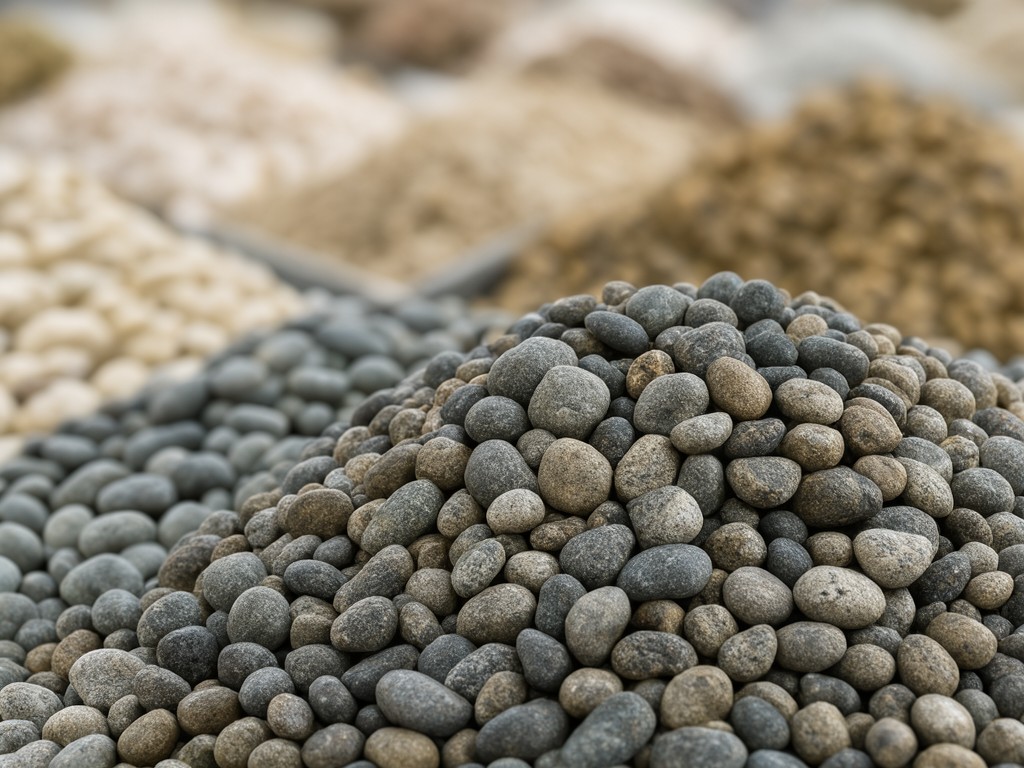
The structural integrity of the pebble depends on the geological formation. Sedimentary river stones are more prone to delamination under heavy load compared to metamorphic or igneous varieties, which offer higher compressive strength for load-bearing driveways.
Polished Grade
Designed for interior water features and decorative mulch where visual clarity and surface smoothness are the primary performance metrics.
Natural Matte
Optimized for exterior landscaping and drainage layers where resistance to weathering and cost per square meter are prioritized.
Size, Weight and Specification Range
Standard shipping is calculated by metric ton or cubic meter. Small-diameter stones (10-20mm) are typically used for filtration layers, while larger stones (50mm+) provide the necessary mass to prevent weed growth and surface surface displacement.
- Small grade (10-25mm): Ideal for tight beds and narrow borders.
- Medium grade (25-50mm): Standard for garden paths and pathways.
- Large grade (50-100mm+): Used for erosion control and architectural accents.
Matching the Product to the Buyer's
Project-specific requirements dictate the ratio of stone-to-substrate. For drainage applications, a higher void ratio is necessary, which requires a more uniform particle distribution to prevent clogging of the sub-base.
Private-label buyers should specify the color-tolerance range for retail packaging, as natural variations in mineral content are inevitable between different quarry sites or riverbeds.
Export Packaging and Handling
Bulk orders are secured in heavy-duty UV-stabilized bulk bags (FIBCs) or packed containers. For international export, palletized loads with shrink-wrap are standard to prevent shifting and moisture ingress during maritime transit.
Storage in a dry, elevated area prevents the accumulation of algae or organic growth, which can complicate the final cleaning process of the stone upon arrival.
Frequently Asked Questions
Most natural river stones are chemically inert, but limestone-based varieties may react to highly acidic soils or fertilizers.
A standard coverage depth of 50mm typically requires 1.5 to 2 tons per square meter depending on stone size.