Buy Outdoor Granite Paving Stone Factory - Bulk Supply and Specification
Design Constraints Behind the Specification
Procuring granite for outdoor infrastructure requires balancingので against mineral density to prevent spalling during freeze-thaw cycles. High-traffic pedestrian zones or commercial plazas demand a stone with a low abrasion coefficient to ensure surface texture does not degrade under mechanical wear. We prioritize blocks with low water absorption, typically below 0.5%, to mitigate internal pressure buildup that leads to structural delamination in extreme climates.
Technical Note: For heavy-duty vehicle applications, a minimum thickness of 80mm is required to prevent shear failure under point loads, regardless of the stone's Mohs hardness rating.
The surface finish directly dictates the coefficient of friction and long-term maintenance requirements. While a flamed finish offers superior slip resistance, a tumbled or honed finish is necessary for aesthetic consistency in areas where moisture or chemical exposure is minimal. We provide batch-specific data based on the quartz content to ensure color consistency across large-scale procurement orders.
How It Is Built and What Changes
Manufacturing begins with precision diamond-cutting of raw granite slabs to ensure dimensional tolerances within a ±2mm range. This precision allows for uniform joint widths during installation, preventing the accumulation of debris or organic growth that often destabilizes the substrate. Post-cutting, the stones undergo thermal treatment or mechanical texturing to remove micro-fractures caused during the sawing process.
- Diamond-wire sawing for high-definition geometric patterns required in modern architectural projects.
- Thermal flaming to create a textured, high-grip surface without compromising the structural integrity of the stone.
- Sandblasting for a matte, non-reflective finish suitable for high-visibility pedestrian walkways.
- Ultrasonic testing on select batches to identify internal voids or structural weaknesses before shipping.
Measured Performance in Real Use
Performance in outdoor environments is judged by the resistance to UV-induced fading and chemical leaching. In environments with high salt exposure from winter maintenance, the chemically inert nature of granite prevents the surface pitting common in softer sedimentary stones. We test the material for salt spray resistance to ensure the paving remains aesthetically and structurally sound over a 20-year service life cycle.
| Parameter | Standard Range | Testing Metric |
|---|---|---|
| Compressive Strength | > 150 MPa | Load-bearing capacity |
| Water Absorption | < 0.5% | Frost-resistance |
| Abrasion Resistance | < 100g | Surface wear loss |
| Density | 2600-2800 kg/m³ | Structural mass |
Specification Range and Customisation
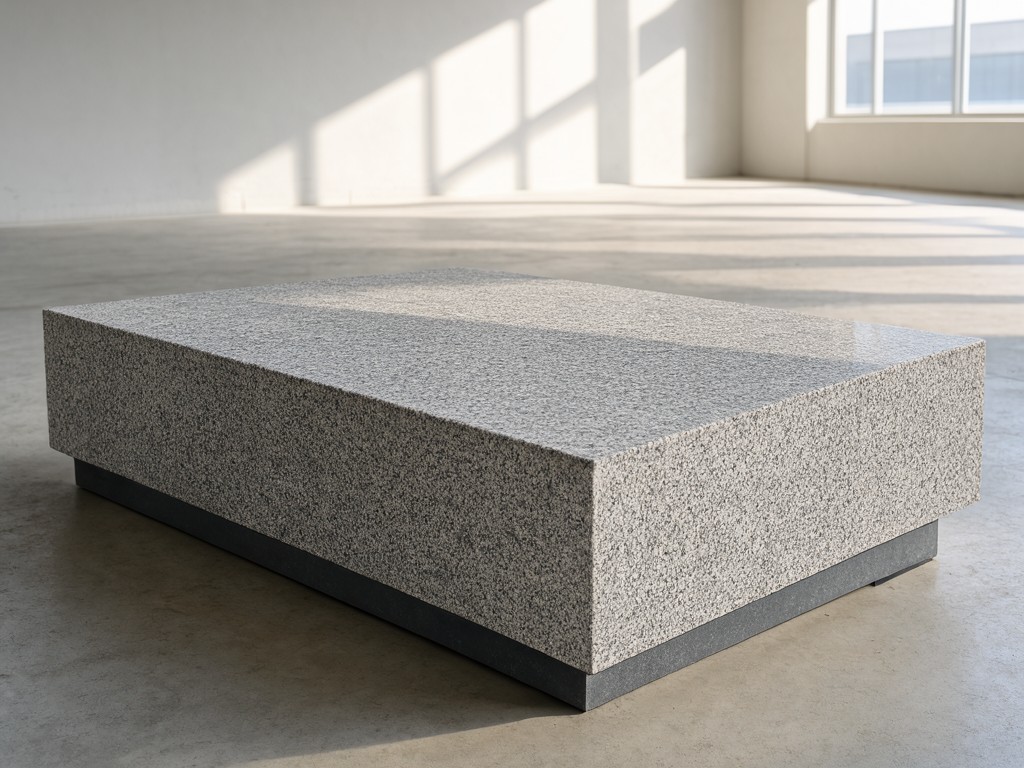
Customization is governed by the specific load requirements of the project site. We offer standard modular sizes for rapid deployment or custom CNC-cutting for complex interlocking patterns.
Standard Sizing
- 100x100mm (Cobble)
- 200x200mm (Square)
- 400x600mm (Large Format)
Thickness Options
- 30mm (Pedestrian)
- 50mm (Light Traffic)
- 100mm+ (Industrial/Heavy)
Customisation Options
Project-specific requirements often necessitate variations in mineral selection to match existing architectural palettes. We source granite from various geological deposits to provide tonal ranges from deep grey to earthy och, while maintaining high-performance mechanical properties.
- Color Selection: Matching specific mineral-density for batch-to-batch tonal consistency.
- Edge Profiling: Beveled, chamfered, or squared edges for specific joint aesthetics.
- Surface Treatment: Application of penetrating sealants to prevent oil staining in porous varieties.
What Gets Checked
Quality control is integrated into the production line to minimize on-site rejection rates. Each pallet undergoes a dimensional check to ensure the stones fit the specified grid pattern without manual adjustment. We also perform visual inspections for hairline fractures or fissures that could compromise the structural integrity under thermal stress.
Final dispatch includes a moisture-content check for sealed stones and a weight-verification against the shipping manifest. This ensures that the material arrives at the project site with the exact volume specified in the procurement contract, preventing logistical delays.